How Technology Supports Value-Based Care in US Healthcare


Listen to the article
Prefer listening over reading? Press play to hear the full article.
Healthcare organizations have traditionally been paid largely for delivering services. A patient has an appointment, a physician provides care, the service is documented, a claim is submitted, and the provider receives payment according to the applicable reimbursement rules.
Value-based care raises a broader question: what happened to the patient after those services were delivered?
Did the patient's condition improve? Were important preventive services completed? Could we have prevented an avoidable hospital visit? Is a population receiving appropriate care? And ultimately, what does it cost to achieve those results?
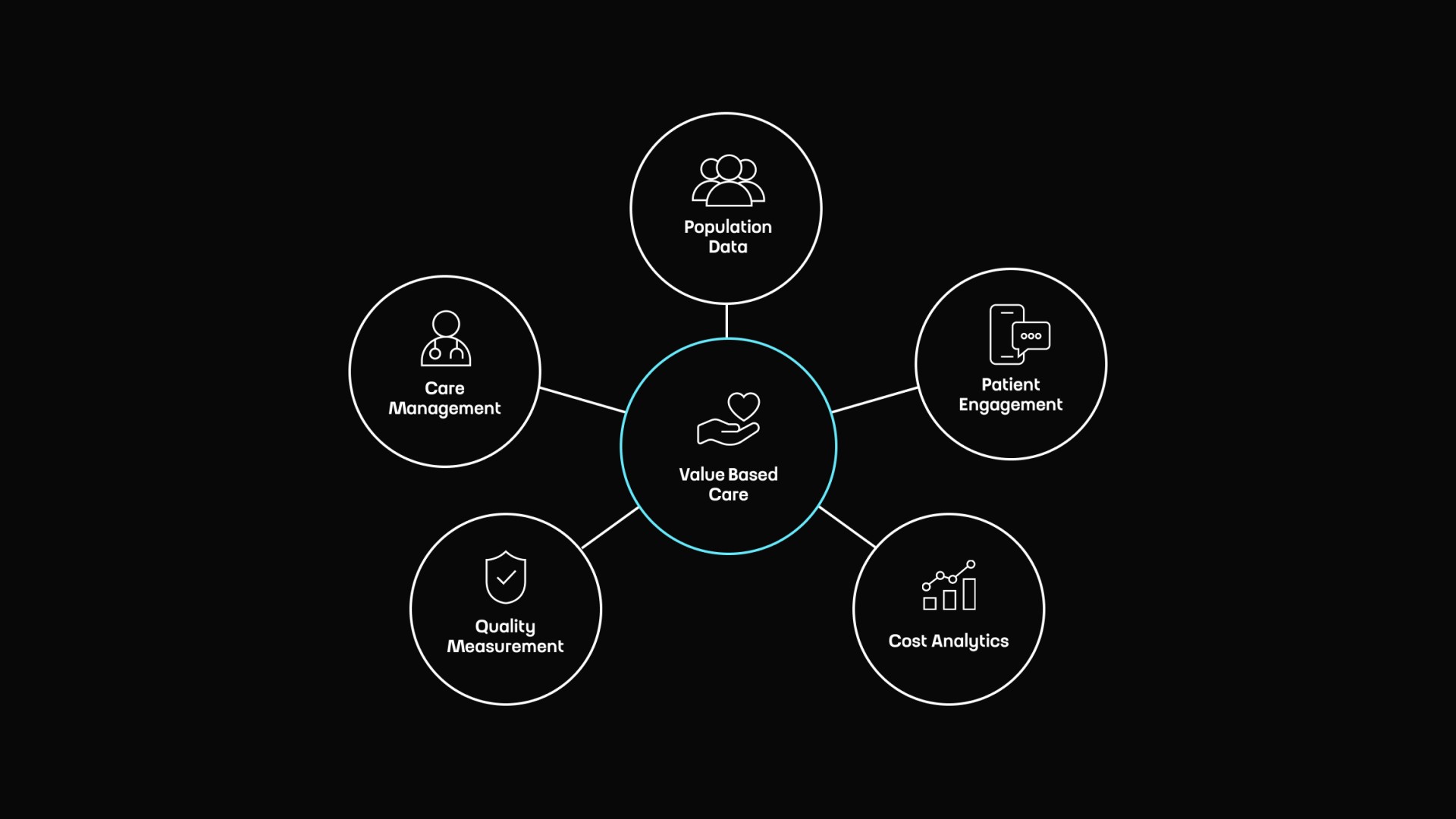
Answering that question requires clinical, operational, and financial information to work together. Value-based care technology can help healthcare organizations understand patient populations, coordinate interventions, measure quality, and analyze how care affects healthcare utilization and cost.
About This Article
This article draws on work the Touch4IT team delivered for BigHeart and MyOwnDoctor, organizations we have worked alongside for several years while developing healthcare technology in the United States.
What Changes Under Value-Based Care?
Under a traditional fee-for-service model, individual healthcare services can generate individual payments. The financial model closely follows the activity performed.
Value-based arrangements can introduce incentives tied to broader measures such as healthcare cost, quality, and performance across a defined population. Shared savings arrangements are one example. If an organization manages a population at a lower cost than an established benchmark while meeting applicable quality requirements, it may share a portion of the resulting savings with participating healthcare organizations.
Other payment models can also shift attention from individual encounters to populations. Per-member-per-month payments, capitation, and bundled arrangements can create financial responsibility that extends beyond a single patient visit.
This changes what healthcare organizations need from their technology.
A system designed primarily to document individual encounters and generate claims answers questions about specific services. Organizations operating under value-based arrangements may also need to understand what is happening across hundreds, thousands, or even hundreds of thousands of patients.
That requires a different level of population visibility.
The Patient Population Becomes the Unit of Analysis
Consider a healthcare organization responsible for a population of patients with diabetes.
Knowing that one patient completed an appointment is useful. But managing the population requires broader questions.
Which patients have diabetes? Which have not been seen recently? Which are missing important screenings? Which patients have additional chronic conditions? Which are repeatedly using emergency services? Which patients are enrolled in care management programs? Which interventions have actually been completed?
Healthcare technology must organize information so teams can move between the individual patient and the population.
Population management therefore becomes important in value-based care. Clinical records still matter, but organizations also need dashboards, registries, reporting infrastructure, and workflows that help identify groups of patients requiring attention.
Technology can then help turn those insights into action.
A care gap identified in the data can generate outreach. A patient with a chronic condition can be enrolled in a monitoring program. A missed preventive service can create a task. A concerning measurement can trigger clinical review.
The value comes from connecting the information with an operational response.
Claims Data Provides Part of the Picture
Claims data becomes particularly useful when organizations need to understand healthcare utilization and cost.
A claim contains structured information about a healthcare service, including the patient, provider, diagnosis, procedure, and date of service. Once adjudicated, claims can also provide financial information about healthcare delivery.
Across a population, this creates a record of healthcare activity that helps organizations understand utilization patterns.
But claims data has limitations.
A claim can show that a service happened. It does not necessarily explain everything that happened clinically before or after that service. It may not show whether a patient responded to outreach, whether a care manager intervened, whether a home measurement changed, or why a patient failed to complete a recommended activity.
For value-based care technology, the challenge is therefore to connect claims with other information sources.
Clinical records provide more detailed care information. Patient engagement systems show interactions outside appointments. Remote monitoring can provide measurements from the patient's home. Care management systems can record interventions and tasks. Eligibility information helps establish which patients belong to the population being managed.
Together, these sources create a much richer picture of what happened to the patient.
Remote Patient Monitoring Shows the Economic Logic
Remote patient monitoring provides a useful example of how technology can support value-based care.
Imagine a population of patients with chronic conditions who are at risk of deterioration. Without monitoring between appointments, a worsening condition might remain unnoticed until the patient requires urgent or hospital care.
A remote monitoring program can collect relevant measurements while the patient is at home. When the data indicates a potential problem, the healthcare team can review it and intervene earlier.
The value-based care question is broader than whether the measurement was successfully transmitted.
The organization needs to understand whether the program changed outcomes for the population.
Were high-risk patients successfully enrolled? Did they continue participating? Were abnormal measurements detected? Did clinicians respond? Did utilization change? Were hospitalizations or emergency visits different from what would otherwise be expected? What did the program cost to operate?
If an organization participates in an arrangement where financial performance depends partly on healthcare utilization or total cost, demonstrating those relationships can become economically important.
Programs such as remote patient monitoring therefore require reporting, claims analysis, and quality measurement alongside clinical functionality.
Simply collecting measurements is only the beginning.
Patient Engagement Becomes Part of the Value-Based Care Infrastructure
A population health program cannot create much value if the patients who need it never participate.
This makes patient engagement operationally important.
Healthcare organizations may identify patients who need an annual assessment, preventive screening, chronic disease follow-up, remote monitoring, or another intervention. Technology can help identify those patients, but someone or something still needs to move them toward the appropriate healthcare action.
Automated outreach can handle part of that process. Other patients may require phone calls, care management, or more direct assistance.
The important point is that patient engagement data should not exist completely separately from the rest of the healthcare operation.
If the objective is to close a care gap, the system should ideally be able to determine whether the gap was actually closed. If a patient is referred to a service, the organization benefits from knowing whether the service happened. If a patient enters a care program, participation and subsequent healthcare activity need to remain measurable.
Value-based care therefore provides a strong reason to link patient engagement to clinical and population data.
Risk Makes Patient Populations More Complicated
Not every patient has the same expected healthcare needs.
A healthy person with few medical conditions likely needs different healthcare resources than someone managing several chronic diseases. Comparing organizations or populations without considering those differences can therefore produce misleading conclusions.
Risk adjustment provides mechanisms for accounting for differences in expected healthcare needs or costs within certain healthcare programs and payment models.
For healthcare technology, this makes accurate patient information and clinical documentation important beyond the immediate encounter. Depending on the program, diagnosis information and other patient characteristics can contribute to risk measurement and downstream financial calculations.
This creates another connection between clinical software and healthcare economics.
Information documented during care may later contribute to population segmentation, reporting, risk measurement, and financial analysis. Systems therefore need to preserve structured and reliable information rather than treating every encounter as an isolated event.
Quality Has to Be Measurable
Reducing healthcare spending alone is not the objective of value-based care.
If an organization could simply reduce services without considering patient care, lowering cost would be easy. Value-based models therefore commonly link financial performance to measures designed to protect or improve quality.
Technology has to support that measurement.
Healthcare organizations may need to understand whether preventive services were completed, whether patients received appropriate follow-up, whether care gaps were addressed, or whether other required quality measures were achieved.
That creates a basic technical requirement: the events being measured have to exist as reliable data.
If an organization wants to report how many eligible patients completed a particular activity, the system needs to know who was eligible, whether the activity occurred, when it occurred, and how it should be counted.
Reporting therefore starts long before the dashboard.
It starts with the way the product captures healthcare activity.
Reporting Cannot Be Added at the End
This is one of the most important implications for healthcare product development.
Teams sometimes think of reporting as something they can build once the core application is finished. Build the clinical workflow first, collect some data, and create dashboards later.
That approach becomes risky when reporting is connected to contractual or financial performance.
If an organization needs to show what happened across a patient population, the underlying platform must capture relevant events in a structured, reliable way from the start.
A dashboard can only report information that the system has successfully collected.
The platform may therefore need to record enrollment, eligibility, encounters, diagnoses, interventions, outreach attempts, care activities, program participation, clinical measurements, and outcomes depending on the particular care model.
It also needs to maintain the relationships between those events.
Knowing that 10,000 blood pressure readings were collected is very different from knowing which patients generated them, which readings were abnormal, what happened afterward, and how those patients' healthcare utilization changed over time.
That difference is fundamental to value-based care technology.
Value-Based Care Connects Systems That Were Traditionally Separate
This is where the engineering challenge becomes significant.
Clinical care may happen inside an EHR. Claims information may come from a payer or billing system. Remote monitoring data may originate from connected devices. Patient engagement may happen through SMS, phone calls, or an application. Care managers may document interventions in another workflow.
Value-based care requires organizations to understand what is happening across those environments.
That doesn't mean every healthcare organization needs one enormous application that contains everything.
It does mean the information needs to be connected well enough to answer meaningful questions about the population.
Which patients received an intervention? What happened afterward? Which services were delivered? What healthcare utilization followed? What did the care cost? Were quality requirements achieved?
Those questions cross traditional software boundaries.
That's why interoperability, healthcare data architecture, and analytics matter so much as organizations move toward value-based care.
Care Management Needs a Longitudinal View of the Patient
Many healthcare systems are naturally organized around encounters. A patient attends an appointment, the clinician documents what happened, and the encounter is completed.
Value-based care requires understanding what happens over a longer period.
A patient with diabetes, heart failure, or another chronic condition may interact with the healthcare system repeatedly. These may include physician visits, remote monitoring, medication changes, lab tests, referrals, care management calls, and preventive services. Looking at each event independently makes it difficult to understand the overall journey.
This is where care plans and longitudinal patient records become important.
Technology can help healthcare teams define what should happen for a patient, record what has already occurred, and identify what remains outstanding. Care team members can then work from a shared understanding of the patient's needs rather than treating every interaction as an isolated event.
This becomes particularly valuable when organizations are responsible for outcomes across a population. They need to understand both individual encounters and the broader episodes of care that connect them.
For software teams, that creates requirements around patient timelines, care plans, tasks, encounters, episodes, clinical observations, and the relationships between them.
The architecture needs to preserve the patient journey over time.
Healthcare Outcomes Can Depend on What Happens Outside the Clinic
Clinical care represents only part of what influences a patient's ability to manage their health.
A physician can recommend a healthier diet, but the patient may struggle to access appropriate food. A care team can schedule follow-up appointments, but the patient may lack reliable transportation. A physician can prescribe a medication, but financial circumstances may prevent the patient from obtaining it.
These problems become especially relevant as healthcare organizations take on greater responsibility for population outcomes and healthcare utilization.
Community health workers, case managers, and engagement specialists can help identify these barriers and connect patients with appropriate services. Their work may include helping patients access food programs, transportation, housing assistance, or other community resources.
Technology can support this process by recording social needs, connecting patients with available services, coordinating referrals, and tracking whether patients actually received assistance.
The underlying challenge is that medical and social services have historically operated through different organizations and different information systems. Connecting them requires healthcare platforms to account for activities that may happen well outside a traditional clinical encounter.
For value-based care, this information matters because an intervention outside the clinic may affect whether the patient can follow the clinical care plan.
Intervention Tracking Connects Data With Action
Identifying a high-risk patient does not improve their health on its own.
The organization still needs to act on that information.
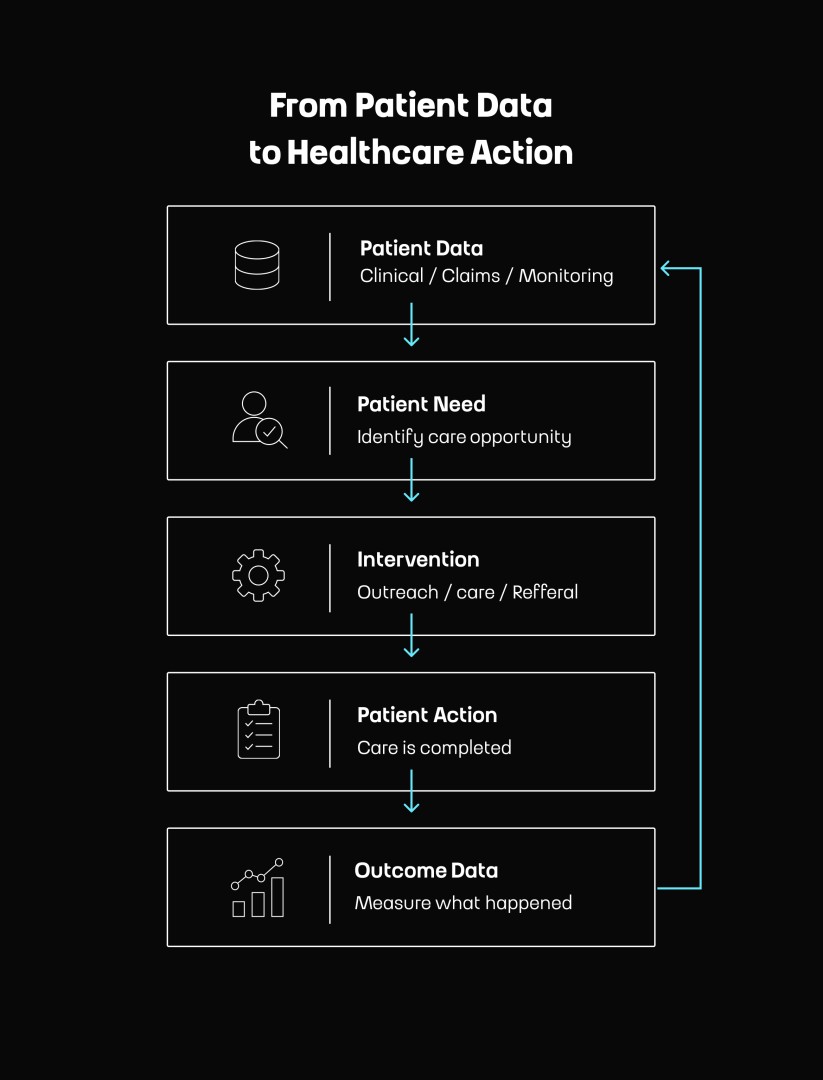
Suppose analytics identifies a group of patients who have not completed an important preventive service. The platform might launch an outreach campaign, create tasks for care managers, or flag patients who need more direct support.
Some patients complete the recommended activity immediately. Others do not respond. Some may need help scheduling an appointment. Others may have transportation, financial, or social barriers that prevent them from completing it.
For a healthcare organization managing a population, knowing that outreach occurred is only one piece of the picture.
The more meaningful question is what happened next.
Technology should connect the original need to the intervention and, where possible, to subsequent healthcare activity. That creates a more useful chain of information:
Patient need → Intervention → Patient response → Healthcare action → Result
The exact workflow will depend on the care model, but the principle applies broadly. To know whether its programs are working, an organization needs visibility beyond the initial problem identification.
Analytics Helps Turn Population Data Into Decisions
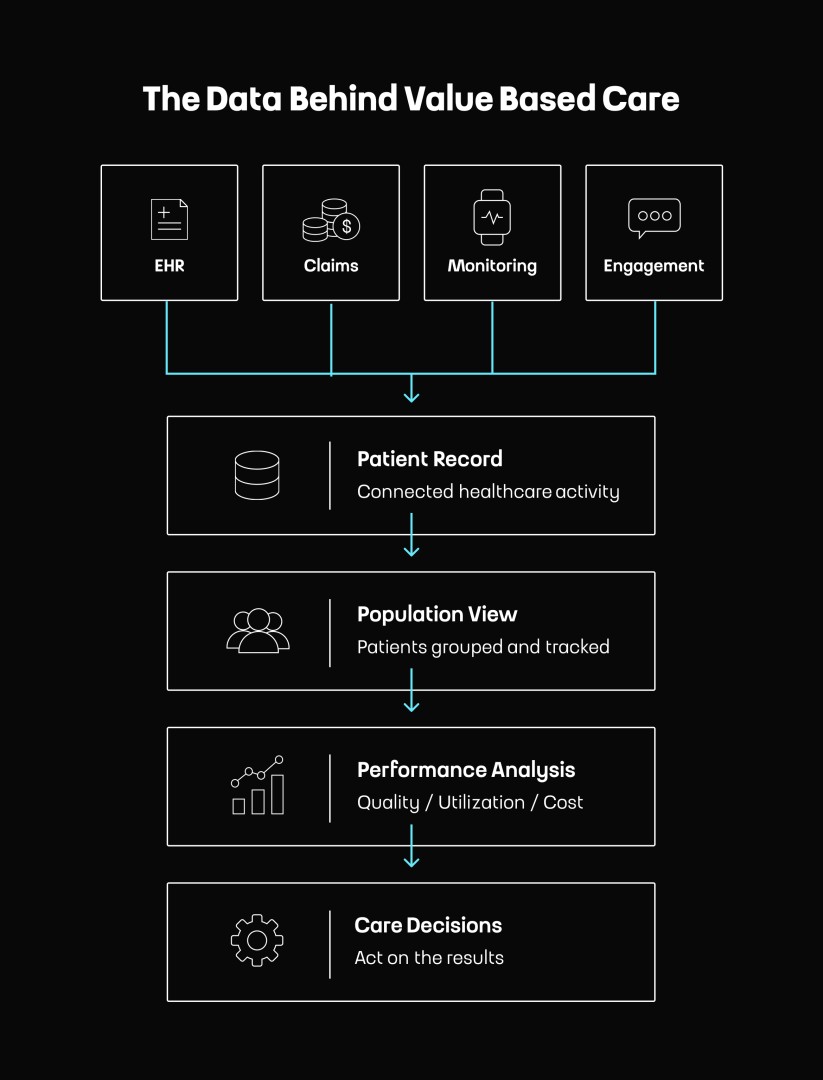
As information from clinical care, claims, patient engagement, and care management comes together, analytics becomes increasingly valuable.
At the operational level, healthcare teams may need to know which patients require attention today. At the management level, organizations may want to understand how many patients are enrolled in a program, whether care gaps are being addressed, or which populations are generating greater utilization.
At the financial level, the questions become broader again.
How much did it cost to manage a particular population? How did healthcare utilization change? Which services were used? Which programs appear to be associated with different patterns of utilization? Are quality requirements being achieved alongside financial objectives?
No single data source can answer these questions, so in value-based environments, reporting has to draw on claims, quality, and service delivery together.
The reporting architecture also needs to preserve enough context to make the numbers meaningful. A count of hospital visits has limited value without knowing which population is being measured, during which period, and under what eligibility criteria.
The same applies to quality measures and program performance.
Good analytics therefore depends heavily on the underlying data architecture.
Proving Savings Is a Data Problem
Shared savings arrangements illustrate this particularly well.
The basic economic concept is relatively straightforward. A defined expected level of healthcare spending is established for a population. The arrangement then evaluates actual performance according to its rules. If spending is below the relevant benchmark and applicable quality requirements are met, participating organizations may become eligible for a share of the savings.
The difficult part is demonstrating what actually happened.
Imagine a remote patient monitoring program intended to identify deterioration earlier and reduce expensive healthcare utilization.
It is easy to report how many patients received devices or how many measurements entered the platform. Those metrics describe activity.
Demonstrating economic value requires considerably more information.
The organization may need to understand which patients participated, their clinical characteristics and risk, how long they remained in the program, what interventions occurred, what healthcare services they subsequently used, and how their costs compared with the relevant benchmark or comparison methodology.
The precise methodology depends on the payment arrangement, but the technological implication is consistent: financial claims about healthcare programs require reliable data.
A digital health product cannot simply claim an intervention saved money because a patient avoided hospitalization. Establishing savings requires an appropriate analytical and contractual framework.
Technology's role is to make the underlying events measurable and provide the data required for that analysis.
Value-Based Care Requires Reliable Patient Attribution
Before an organization can measure performance across a population, it needs to know which patients belong to that population.
This sounds obvious, but it has significant consequences for software.
Patients can change insurance coverage. Programs can have specific eligibility criteria. People can enter and leave populations during a measurement period. Different contracts can apply to different groups of patients.
A dashboard showing “all patients with diabetes” may therefore answer a very different question from a report measuring the population covered by a particular value-based arrangement.
Healthcare technology needs a reliable way to represent membership, eligibility, and relevant time periods so clinical and financial activity can be linked to the correct population.
Without that context, even technically accurate data can produce misleading analysis.
Technology Has to Support the People Delivering the Care
Value-based care technology is often discussed in terms of analytics, artificial intelligence, and population dashboards. Those capabilities can be valuable, but people still do much of the actual work.
Clinicians deliver care. Care managers coordinate services. Schedulers arrange appointments. Engagement teams contact patients. Community health workers help address practical barriers.
Software needs to make those activities easier to coordinate.
That may mean creating work queues for patients requiring follow-up, surfacing care gaps during an encounter, showing recent patient activity, assigning tasks, tracking referrals, or helping staff identify patients who have stopped participating in a program.
The technology's effectiveness therefore depends partly on whether it fits into real healthcare operations.
A sophisticated risk model has limited practical value if the person responsible for acting on its results never sees it.
The connection between analytics and workflow is one of the most important design considerations in value-based care technology.
What Digital Health Companies Should Build for Value-Based Environments
Digital health companies entering value-based healthcare should understand how their product contributes to the broader care and financial model.
For some companies, that contribution may be direct. A platform might manage a patient population, coordinate care and produce reporting required by healthcare organizations or payers.
For others, the product may provide one specific capability, such as remote monitoring, behavioral health support, patient engagement, or chronic disease management.
In either case, buyers may eventually ask questions that go beyond whether the product works technically.
Which patients used it? How frequently? What happened after they used it? Did relevant clinical measures change? Did healthcare utilization change? Can you segment the results by population? Can the information be combined with claims or EHR data? Can the organization use the data in its own reporting?
These questions should influence product architecture early.
Products that capture structured events, maintain reliable patient identities, integrate with healthcare systems, and make their data accessible for analysis are much easier to incorporate into broader value-based care programs.
Integration Becomes a Strategic Capability
Few digital health products contain all the information required for value-based care.
An EHR may contain clinical documentation. A payer may hold claims data. A remote monitoring platform may contain measurements. A patient engagement platform may record outreach. A community care organization may document social services.
Understanding the patient across these environments requires information to move between systems.
This is why healthcare interoperability matters strategically.
The challenge is broader than transferring a medical record from one system to another. Organizations increasingly need to combine information from multiple sources to coordinate care, identify intervention opportunities, and measure outcomes across a population.
Standards and APIs can support this exchange, but the engineering work also involves identity matching, permissions, data quality, terminology, event timing, and understanding what each piece of information actually means in its original system.
We will explore those challenges in more depth in our article on healthcare interoperability in practice.
Value-Based Care Changes the Role of Healthcare Software
Under a simple transactional model, software can focus heavily on helping healthcare professionals deliver and document individual services.
Value-based care expands that responsibility.
Healthcare organizations need technology that helps them understand populations, identify patients who need intervention, coordinate activities across teams, connect information across systems, and measure clinical, operational, and financial performance over time.
The software increasingly becomes part of the infrastructure the organization uses to manage care.
That has consequences for product design.
Reporting cannot be separated from the data being captured. Patient engagement cannot be completely separated from clinical workflows. Claims cannot be completely separated from utilization analysis. You cannot evaluate remote monitoring solely by the number of measurements collected.
The different parts of the system must ultimately contribute to a coherent picture of what happened to the patient and the population.
Final Thoughts
Value-based care creates a demanding technology environment because healthcare organizations are trying to connect activities that traditionally lived in separate systems.
Clinical care happens in one place. Claims may come from another. Patients interact through digital channels, phone calls, and in-person visits. Remote devices generate additional data. Care managers coordinate interventions. Community organizations may address needs that influence whether a patient can follow the care plan.
Then someone has to determine whether the population received appropriate care, whether quality requirements were achieved, and what the care ultimately cost.
Technology makes that possible by creating continuity between these activities and making them measurable.
For digital health companies, this is also an important commercial lesson. A product that can show how it fits into a healthcare organization's clinical and economic objectives is easier to evaluate than one that provides another isolated stream of healthcare data.
Building Technology for Value-Based Healthcare?
Touch4IT has more than six years of experience developing healthcare technology for the US market, including platforms supporting large Medicaid populations.
Our healthcare engineering work spans patient engagement, care management, EHR functionality, telehealth, healthcare integrations, reporting, and analytics.
We work with digital health companies and healthcare organizations that need to turn complex care models into software that can operate reliably at scale.
If you are building or expanding a healthcare platform for the US market, talk to Jan, our healthcare lead.
FAQs
1. What is value-based care?
Value-based care is an approach to healthcare that links financial performance to factors such as quality, healthcare costs, and outcomes across a defined patient population. Depending on the payment model, healthcare organizations may have incentives to improve care while managing avoidable utilization and overall spending.
2. How does technology support value-based care?
Technology supports value-based care by connecting clinical information, claims, patient engagement, care management, remote monitoring, and analytics. This lets healthcare organizations identify patients who need intervention, coordinate care, track activity, and measure performance across populations.
3. What role does data analytics play in value-based care?
Data analytics helps healthcare organizations understand what is happening across a patient population. It can support care gap identification, population segmentation, utilization analysis, quality measurement, and financial reporting. The quality of these insights depends heavily on how consistently the underlying clinical and operational data is captured.
4. How can remote patient monitoring support value-based care?
Remote patient monitoring can help healthcare teams observe patients between traditional appointments and identify potential problems earlier. In value-based environments, organizations may also analyze whether participation in monitoring programs is associated with changes in clinical measures, interventions, healthcare utilization, and costs.
5. Why is interoperability important for value-based care?
Value-based care often requires information from multiple systems, including EHRs, payer systems, claims databases, remote monitoring platforms, and patient engagement tools. Interoperability lets these systems exchange information so healthcare organizations can build a more complete view of a patient's care and measure performance across a population.
6. What should digital health companies consider when building for value-based care?
Digital health companies should consider how their technology will capture structured patient activity, integrate with healthcare systems, support population reporting, and demonstrate post-intervention outcomes. Buyers may want to know who used the product, what care was delivered, what happened afterward, and whether the resulting data can support clinical, quality, utilization, or financial analysis.