What Makes EHR Software So Complex? Inside the Workflows Behind Modern Healthcare Systems


An electronic health record might appear relatively straightforward from the outside. A clinician opens a patient record, reviews medical history, documents an appointment, prescribes medication, and saves the information.
But building the software that makes those activities possible is considerably more complicated.
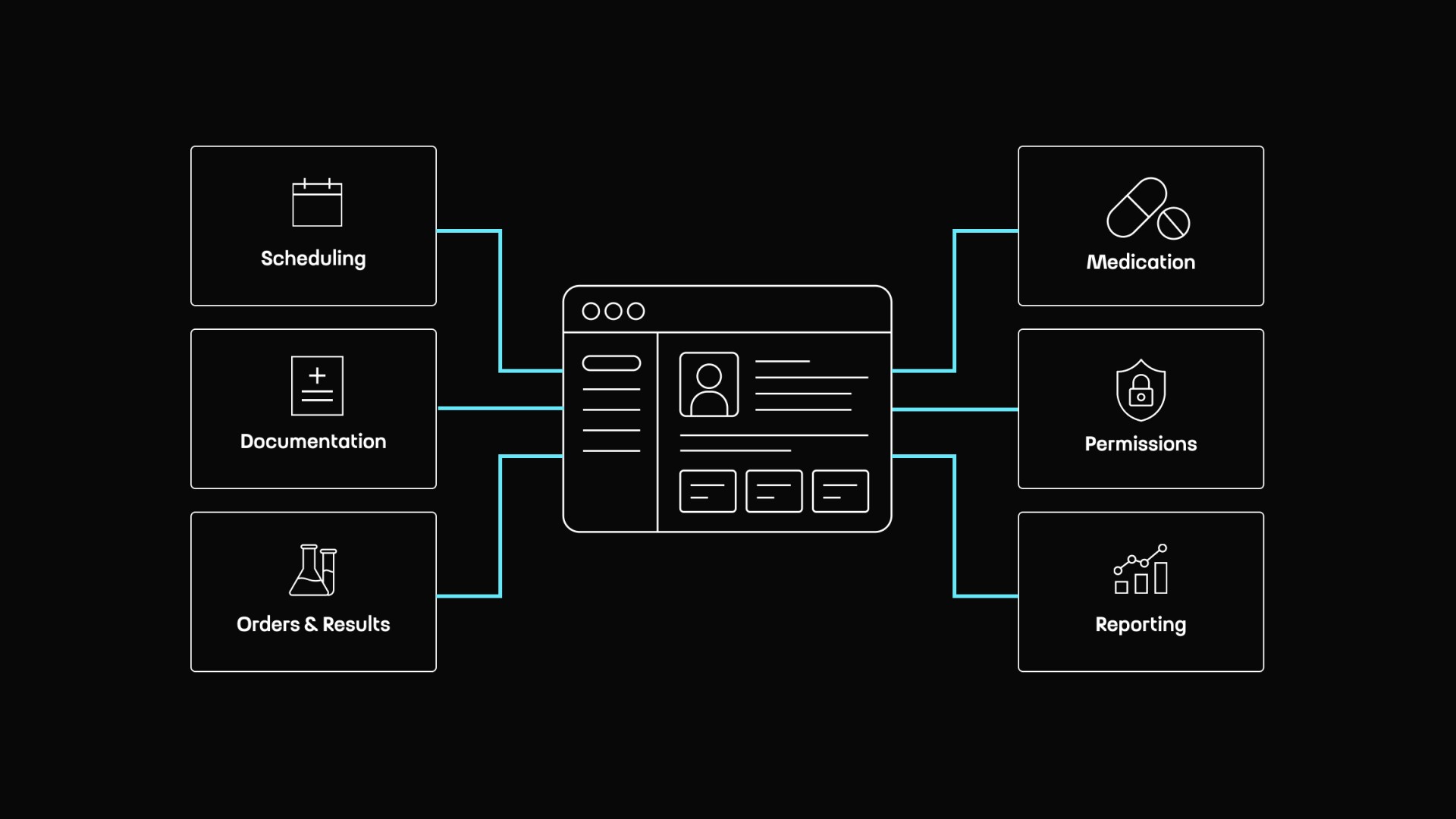
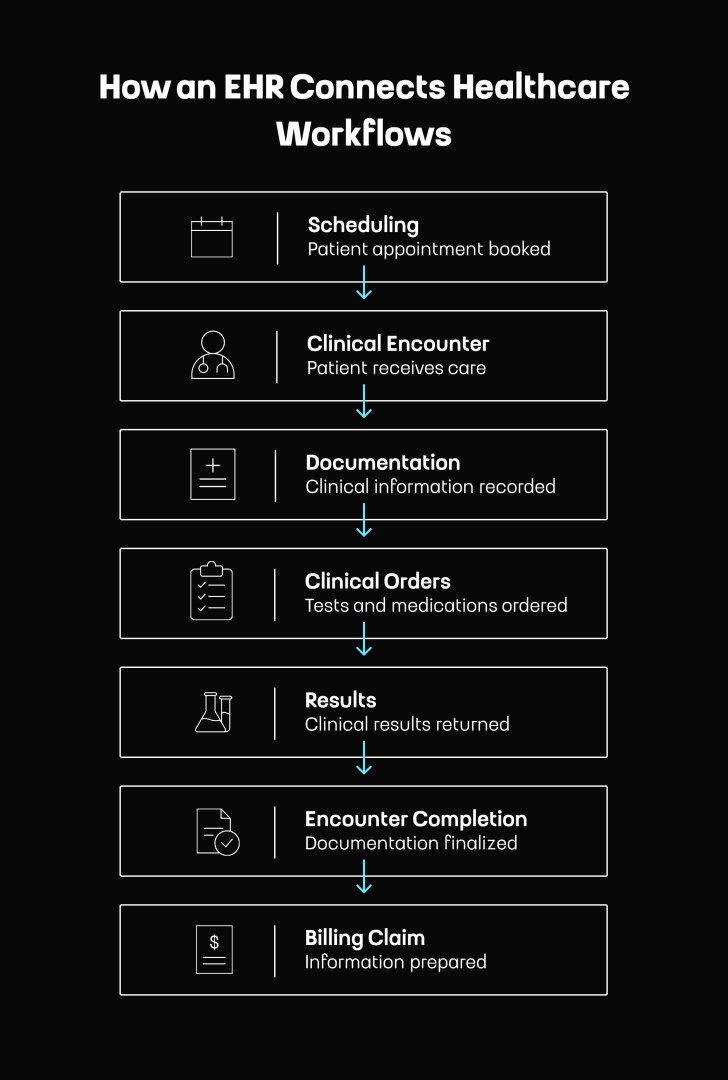
A single patient appointment can involve scheduling staff, physicians, nurses, laboratory departments, pharmacies, billing teams, and insurance companies. Each participant needs different information, performs different activities, and operates under different clinical and administrative rules.
Some workflows happen simultaneously. Others depend on a previous action. A physician may need to sign a clinical note before billing information becomes available. A medication order may require safety checks before it can proceed. A diagnostic procedure may depend on the availability of a particular room, device, or specialist.
All of these activities need to remain connected to the correct patient and clinical context.
This is what makes EHR software development particularly challenging. The complexity comes from translating healthcare organizations' everyday operations into reliable software workflows.
An EHR Serves Multiple Healthcare Professionals
One of the first challenges in EHR development is that different healthcare professionals interact with the same system in fundamentally different ways.
Consider a hospital or a large outpatient healthcare organization.
A receptionist or scheduling coordinator may spend most of the day managing appointments, checking patient information, verifying insurance coverage, and coordinating available resources.
A physician needs access to clinical history, diagnoses, medications, allergies, previous encounters, and documentation tools. During the appointment, the physician may create clinical notes, order tests, prescribe medication, or review results.
A nurse may take vital signs, administer medications, perform patient assessments, and provide care activities. Laboratory personnel need to receive orders, process specimens, and communicate results. Billing staff need information about services delivered, medical codes, insurance details, and claims.
These professionals work with overlapping patient information, but their responsibilities are different.
A well-designed EHR therefore needs to present information and functionality according to the user's clinical or administrative role.
This affects navigation, permissions, data structures, and workflow design. A scheduling coordinator should be able to perform scheduling tasks without automatically receiving unrestricted access to every clinical function. Clinicians need a different interface because their work involves clinical decisions, documentation, and treatment.
The challenge becomes greater when multiple departments and professional roles contribute to the same patient journey.
Scheduling Is More Complicated Than Managing a Calendar
Scheduling is a useful example of how seemingly simple EHR functionality becomes complex in a real healthcare environment.
In a basic appointment booking application, a user selects a date, chooses an available time, and confirms the reservation.
Healthcare scheduling may involve considerably more information.
An appointment may require a specific clinician type, a particular duration, an examination room, medical equipment, or a combination of resources. Different appointment types can have different scheduling requirements.
For example, scheduling an MRI examination involves different resources and constraints than scheduling a routine physician consultation. A diagnostic procedure may require a particular device, an appropriate room, and an available specialist.
EHR scheduling systems may use appointment templates to represent these requirements. Templates can define appointment duration, available time slots, and required resources.
The system then needs to prevent conflicting reservations while ensuring that the correct resources are available.
Scheduling may also connect with insurance verification. When a patient books an appointment, the system can initiate an eligibility inquiry to confirm active coverage and obtain available information about benefits or financial responsibility.
That information may reach the front desk before the patient arrives.
As a result, healthcare scheduling can connect calendar management, patient demographics, provider availability, resource allocation, insurance information, and financial workflows.
What appears to be a simple booking screen may depend on several interconnected systems.
Clinical Documentation Has to Support Real Medical Work
Clinical documentation is a central function of an EHR.
During an encounter, healthcare professionals need to record relevant information about the patient's condition, observations, assessment, and treatment.
However, clinical documentation is rarely just an unrestricted text field.
Healthcare organizations often use structured documentation templates designed for particular specialties, encounter types, or clinical activities. These templates help clinicians capture information consistently while reducing repetitive work.
A physician documenting a routine consultation may need a different template from someone performing a specialist assessment or a diagnostic procedure.
Modern EHR systems can also provide smart text functionality, reusable phrases, and tools that help clinicians complete documentation more efficiently.
The underlying challenge is balancing flexibility with structured information.
Clinicians need enough freedom to document the clinical situation accurately. At the same time, healthcare organizations need information that can support future care, reporting, coding, and other downstream processes.
A diagnosis recorded during an appointment may later support billing, care management, population health reporting, or clinical decision support.
The EHR therefore needs to preserve important clinical information in a form that other workflows can use.
Why Signing a Clinical Note Matters
Completing a clinical note can also trigger additional activities.
In some EHR workflows, signing the note indicates the documentation is finalized and can be used by downstream processes.
For example, a completed encounter may provide information needed to generate a healthcare claim, including the relevant diagnoses, services, provider, and date of service.
Before submitting the claim, the information may pass through coding, validation, and billing processes.
This creates a direct relationship between clinical documentation and financial operations.
If required information is missing, inconsistent, or incorrectly structured, the problem may not become visible until later in the billing process.
EHR software must therefore support clinical workflow while preserving the information connected administrative systems require.
Clinical Decision Support Adds Another Dimension
EHR software can also assist clinicians by presenting relevant information during care.
Clinical decision support can take different forms depending on the healthcare organization and the type of clinical activity.
For example, a prescribing workflow may include alerts related to medication allergies or potential drug interactions. A patient record may highlight overdue screenings or unresolved care gaps. Documentation tools may provide contextual information or structured suggestions.
These capabilities require the software to interpret information already in the patient's record and make it available at the right point in the workflow.
For instance, a medication alert depends on access to relevant medication and allergy information. A care gap notification depends on understanding the patient's clinical history and the criteria used to identify the gap.
The timing of these notifications matters.
A system that presents relevant information during the appropriate clinical activity can support decision-making. A system that interrupts clinicians with excessive or poorly contextualized alerts can create additional work.
Developing clinical decision support therefore requires an understanding of how clinicians actually use the EHR during an encounter.
It also creates technical requirements for data quality, clinical terminology, configurable rules, and information presentation.
Orders and Results Connect Different Departments
An encounter may involve activities that extend beyond the clinician's immediate interaction with the patient.
A physician may order a laboratory test, request diagnostic imaging or prescribe medication. These activities create workflows involving other departments or external systems.
Computerized Provider Order Entry, commonly called CPOE, allows clinicians to create and manage orders electronically.
But creating an order is only the beginning of the process.
A laboratory order may need to reach the right department, be linked to a specimen, move through processing, and eventually produce a result that becomes available in the patient's record.
A diagnostic imaging order may involve scheduling, equipment availability, completing the examination, and a report from the responsible specialist.
Medication orders can involve additional clinical checks and communication with pharmacy systems.
For the EHR, the challenge is maintaining the relationship between the original order, its status, the associated encounter, and the resulting clinical information.
Healthcare professionals need to know whether an order is pending, completed, or requires further attention. Results must be linked to the correct patient and available to the appropriate care team.
These processes can involve multiple applications and departments, making integration and workflow coordination important parts of EHR development.
The Patient Record Has to Maintain Clinical Context
An EHR contains information collected across many interactions with the healthcare system.
A patient may have previous diagnoses, medications, allergies, laboratory results, specialist consultations, hospital admissions, and ongoing care plans.
The software needs to make this information accessible while preserving its clinical context.
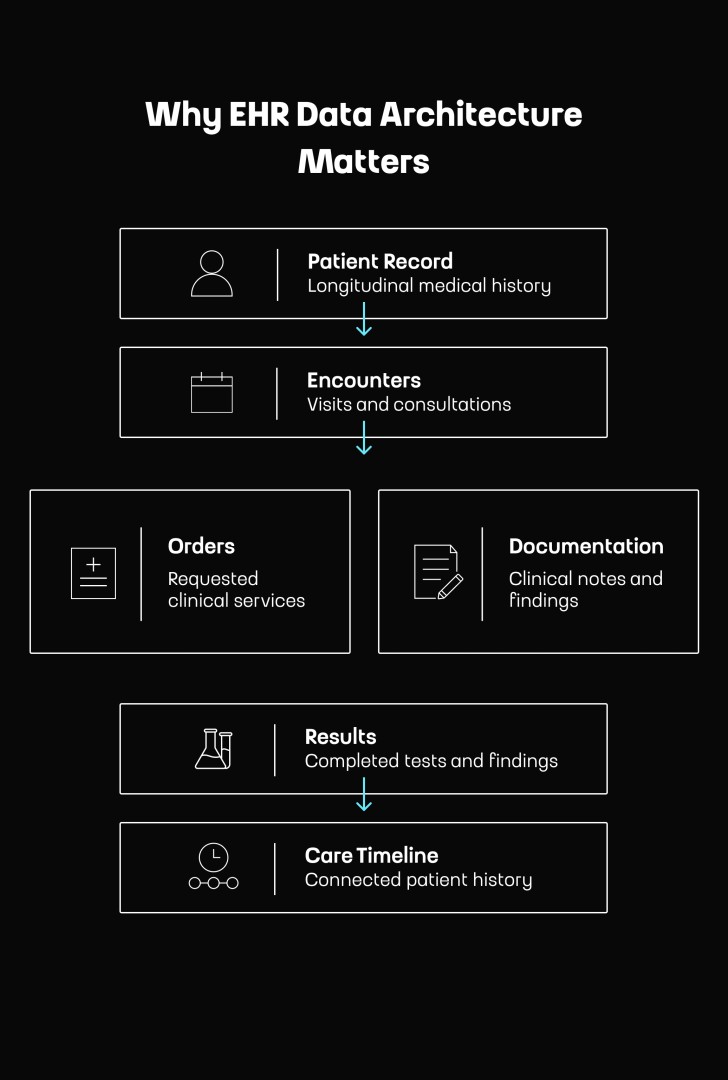
A laboratory result belongs to a particular patient and may be associated with a specific order and encounter. A medication may be prescribed during one visit and later changed during another. A diagnosis may relate to a particular clinical episode or remain relevant across multiple encounters.
These relationships become increasingly important as the patient's medical history grows.
Without appropriate structure, the EHR risks becoming a collection of disconnected records that clinicians find difficult to interpret.
A well-designed system needs to help healthcare professionals understand what happened, when it happened, and how the information relates to the patient's ongoing care.
This also creates the foundation for more advanced functionality, including clinical decision support, care coordination, and population health reporting.
Inpatient and Outpatient EHR Workflows Have Different Requirements
Healthcare organizations do not all operate in the same way. A primary care practice, a specialist clinic, and a hospital may use electronic health records, but the workflows they need to support can differ substantially.
In an outpatient setting, the EHR often revolves around scheduled appointments and individual encounters. A patient arrives for a consultation; the clinician reviews the record, documents the visit, orders any necessary tests or medications, and completes the encounter.
Inpatient care adds complexity because a patient may remain in the hospital for several days or longer.
During that time, multiple clinicians and departments may contribute to the patient's treatment. Nurses record observations, physicians update treatment plans, medications are administered, laboratory tests are ordered and reviewed, and the patient's condition may change throughout the admission.
The EHR must support continuity across these activities while maintaining a reliable record of who performed each action and when it occurred.
Hospital workflows also involve admission, discharge, and transfer processes, commonly referred to as ADT. These events represent important changes in the patient's status and location within the healthcare organization.
For example, when a patient is admitted, the system may need to associate the patient with a particular hospital stay, department, or care team. A transfer can change which professionals are responsible for the patient. Discharge involves completing the relevant clinical and administrative activities and preparing information needed for continued care.
These requirements make inpatient EHR development considerably different from building software primarily around outpatient appointments.
Medication Management Requires More Than Electronic Prescriptions
Medication workflows illustrate another important difference between outpatient and inpatient care.
In an outpatient setting, a physician may prescribe medication during an encounter and send the prescription to a pharmacy. The EHR needs to record the medication, dosage, instructions, and relevant clinical information.
In a hospital, medication management can involve additional steps.
A clinician orders medication; the order may require review or verification, and nursing staff administers the medication according to the applicable clinical workflow. The administration itself needs to be documented.
This distinction matters because prescribing medication and administering medication are different clinical events.
A medication order reflects what was prescribed. A medication administration record documents what the patient actually received, including details such as time and dose.
An inpatient EHR may therefore need to support medication orders, verification, administration schedules, administration records, and treatment changes.
The information must also remain connected to the patient's current clinical context.
For software developers, this creates requirements around workflow states, permissions, timestamps, medication information and the relationships between orders and completed activities.
It also shows why copying functionality from a general appointment management application isn't enough for complex hospital environments.
Admissions, Transfers and Discharges Connect Clinical and Administrative Systems
Admission, discharge, and transfer events affect more than the patient's location.
When a patient enters a hospital, different departments may need to know that the admission has occurred. During the stay, the patient's care may involve laboratory services, imaging, medication management, and consultations with different specialists.
When the patient is transferred, the responsible care team or department may change. When the patient is discharged, the organization may need to complete documentation, provide instructions, and communicate information to other healthcare providers.
These events can also matter to systems outside the hospital.
For example, information about a patient's admission or discharge may be relevant to care coordination programs that need to arrange follow-up after hospitalization.
This creates a requirement for reliable communication between the EHR and other healthcare systems.
The software must accurately reflect the patient's current status while preserving the history of previous events.
If admission and discharge information is inconsistent, other systems may receive an incomplete or misleading picture of the patient's care journey.
Permissions and Auditability Are Fundamental to EHR Architecture
EHR systems contain highly sensitive patient information and support activities with clinical consequences.
As a result, access management must be considered from the start of development.
Different healthcare professionals require different capabilities. A scheduling coordinator may need access to appointments, demographics, and insurance information. A physician needs clinical documentation and ordering functionality. Nursing staff may require medication administration and patient assessment workflows.
Billing personnel need access to information relevant to claims and financial operations.
Role-based access controls can reflect these differences by determining what users can view or do.
However, real healthcare permissions can become more complex than assigning a single role to every user.
A healthcare professional may work across multiple departments or facilities. Access may depend on organizational responsibilities, the patient's care context, or the specific activity being performed.
The system also needs to maintain accountability.
Healthcare organizations need to know who accessed information, who changed a record, who entered an order, and who completed key clinical activities.
Audit trails support that accountability by recording relevant system events.
From an engineering perspective, permissions and auditability affect much more than the login screen. They influence application architecture, data access, workflow design, and how clinical actions are recorded.
Interoperability Adds Complexity Beyond the EHR Itself
An EHR rarely operates in complete isolation.
Healthcare organizations use laboratory systems, imaging systems, pharmacy applications, billing platforms, patient portals, insurance services, and other technologies that need to exchange information.
Some integrations support clinical activities. Others support administrative or financial processes.
For example, laboratory results must reach the correct patient record. Scheduling may require insurance eligibility information. Clinical documentation may contribute to claims generation. Admission and discharge information may be shared with care coordination systems.
The difficulty is that these systems may represent information differently.
Even when standardized exchange formats are available, integration requires understanding the meaning and context of the data being transferred.
An encounter, an order, a result, and a diagnosis represent different healthcare concepts. Their relationships matter because downstream systems need to interpret the information correctly.
Patient identification is another challenge. Information arriving from an external system must be associated with the correct person and, where applicable, the correct encounter or order.
Healthcare interoperability therefore involves both technical communication and accurately representing clinical information.
For EHR developers, this means integration requirements should influence the data architecture from the beginning.
A system that works well in isolation can become difficult to extend if its underlying information model cannot support the relationships required by external healthcare systems.
EHR Reporting Serves Clinical, Operational and Financial Purposes
EHR systems generate information that healthcare organizations use for much more than individual patient care.
Clinical teams may need reports on patient activity, diagnoses, treatments, or care gaps. Administrators may want to understand appointment utilization, department activity, or operational performance.
Billing teams need information about completed encounters and services. Organizations participating in population health programs may need to report across larger patient groups.
These reporting requirements add a challenge for EHR architecture.
A clinical event must be represented in a way that supports immediate workflow while preserving information that may become relevant later.
For example, documenting that a patient completed a screening can support the clinical record. The same information may also be relevant to a quality report or a population health program.
If the event is recorded only as unstructured text, reliably extracting it for reporting can be difficult.
This does not mean every clinical activity should be reduced to rigid fields. Clinicians still need flexibility to document complex medical situations.
However, healthcare organizations benefit when they capture important events, relationships, and workflow states consistently.
Reporting requirements should therefore be considered alongside clinical functionality rather than treated as an entirely separate feature to be added after development.
EHR Data Structures Need to Reflect Healthcare Relationships
One of the less visible challenges in EHR software development is deciding how to represent clinical information.
Consider a patient who attends several appointments for the same condition.
Each appointment may generate an encounter. During those encounters, clinicians may record diagnoses, create orders, review results, prescribe medications, and update the patient's care plan.
Some information belongs to a particular encounter. Other information remains relevant across multiple encounters.
The software needs to preserve these relationships.
A laboratory result may be associated with a specific order. An order may originate during a particular encounter. A care plan may extend across several encounters. A clinical episode may connect multiple interactions relating to the same condition or treatment.
These relationships influence how clinicians navigate the record and how other systems interpret the information.
They also become important for reporting and care coordination.
For example, understanding the total care delivered during a clinical episode requires more than counting appointments. The system needs to understand which encounters and activities belong to that episode.
A poorly designed data model can make these questions difficult to answer even when the underlying information exists somewhere in the database.
This is one reason why EHR architecture requires detailed knowledge of healthcare concepts before development begins.
Automation Depends on Understanding Clinical Workflow States
Healthcare organizations increasingly want to automate repetitive administrative and clinical support activities.
Examples include eligibility checks, documentation assistance, coding suggestions, claims preparation, reminders, and moving information between departments.
Automation can reduce manual work, but only when the system understands the conditions under which an activity should happen.
Consider a workflow in which a completed clinical encounter provides information for billing.
The software needs to know when the documentation is sufficiently complete, whether the relevant clinical information is available, and whether the next activity can proceed.
Similarly, an order may need to remain pending until another department performs the requested service. A result may require review before the workflow is considered complete.
These distinctions are important because healthcare activities often move through several states before completion.
Automating a process without representing those states accurately can create problems. The system might start an activity too early, fail to recognize an incomplete task, or lose track of who is responsible for the next step.
This is why workflow design is fundamental to EHR engineering.
The technical implementation needs to reflect the actual sequence of healthcare activities and the conditions that determine when each activity can proceed.
What Healthcare Companies Should Consider Before Developing EHR Functionality
Not every digital health company needs to build a complete electronic health record.
Many products require only selected EHR capabilities or integrations with an existing system.
A telehealth platform may need scheduling, encounters, clinical documentation, and prescribing. Remote patient monitoring tools, by contrast, focus on linking device observations to the right patient and alerting clinicians when something needs attention.
Care management applications rely on longitudinal records, care plans, and task tracking, while a patient engagement platform typically centers on appointments and communication with the care team.
The first decision should therefore concern the role the product will play in the healthcare workflow.
Will clinicians document care directly inside the application? Will the product exchange information with an existing EHR? Does it need to generate clinical orders? Will it support billing? Does it need to maintain a longitudinal patient record or only selected information relevant to a particular service?
These answers shape the architecture, integrations, permissions, and development scope.
Healthcare organizations should also consider the following questions:
- Which professional roles will use the system? Their responsibilities determine the required workflows, interfaces, and permissions.
- Which clinical activities must the software support? Scheduling, documentation, ordering, medication management, and care coordination have different requirements.
- Which information needs to move between systems? Integration requirements affect the underlying data model and technical architecture.
- What happens when an activity is completed? Downstream workflows may depend on encounter completion, signed documentation, order status, or other events.
- What information will the organization need to report later? Clinical, operational, financial, and quality reporting may depend on data captured during everyday activities.
These decisions are easier to make before development than after the application has already established its core architecture.
Why EHR Software Development Requires Healthcare Domain Expertise
Building reliable EHR functionality requires more than familiarity with databases, APIs, and application frameworks.
Software teams need to understand the clinical and administrative activities the product must support.
They need to distinguish an encounter from an episode of care, an order from a result, a prescription from a medication administration, and clinical documentation from the information required for billing.
They also need to understand how different healthcare professionals interact with the same patient record and how information moves between departments and external systems.
Without that understanding, it is easy to underestimate the complexity of seemingly ordinary features.
A scheduling module becomes a resource management problem. Clinical documentation affects coding and reporting. Medication workflows require carefully defined states. Permissions influence how every professional interacts with the application.
These dependencies matter more as a healthcare product grows.
A platform that initially supports a small number of straightforward workflows may eventually need to accommodate additional specialties, professional roles, integrations, and operational requirements.
The ability to extend the system without repeatedly rebuilding its foundations depends heavily on the original architecture.
Final Thoughts
Electronic health records are among the more complex categories of healthcare software because they connect so many different activities within a healthcare organization.
They support clinicians delivering care, administrative staff coordinating appointments, departments processing orders, billing teams preparing claims, and organizations reporting on clinical and operational performance.
Each activity has its own requirements, but they all depend on information about the same patients and their care.
For healthcare organizations and digital health companies, understanding this complexity is important before deciding what to build.
The most significant engineering challenges often emerge from the relationships between workflows rather than the individual features themselves.
A successful EHR implementation needs to represent those relationships accurately while remaining practical for the healthcare professionals who use it every day.
Building or Extending EHR Software?
Touch4IT has more than six years of experience developing healthcare technology for the US market, including our long-term engineering partnership with BigHeart, a healthcare platform supporting large Medicaid populations.
Our work includes EHR functionality, telehealth, patient engagement, care management, healthcare integrations, clinical workflows, and data infrastructure.
We help healthcare organizations and digital health companies design, develop, and extend software that must operate in complex clinical and administrative environments.
If you are developing EHR functionality, modernizing an existing healthcare platform or integrating your product with healthcare systems, talk to Jan, our healthcare lead.
FAQs
1. What makes EHR software development so complex?
EHR software development is complex because it must support interconnected clinical, administrative, and financial workflows. Scheduling, clinical documentation, medication management, orders, results, billing and reporting all have different requirements. The system must also maintain accurate patient information, enforce access permissions, and exchange data with other healthcare applications.
2. What are the most important features of an EHR system?
Common EHR features include patient records, appointment scheduling, clinical documentation, medication management, computerized provider order entry (CPOE), laboratory and diagnostic results, clinical decision support, and reporting. Depending on the healthcare setting, an EHR may also require inpatient workflows, insurance eligibility verification, billing integrations, and care coordination functionality.
3. What is the difference between inpatient and outpatient EHR software?
Outpatient EHR software typically focuses on scheduled appointments, consultations, clinical documentation, and follow-up care. Inpatient EHR software must also support hospital admissions, transfers, discharges, continuous patient monitoring, medication administration, and coordination between multiple departments. These differences significantly affect workflow design, data structures, and system architecture.
4. Why is healthcare interoperability important in EHR development?
Healthcare interoperability allows EHR systems to exchange information with laboratories, pharmacies, imaging systems, billing platforms, insurers, and other healthcare applications. Effective interoperability ensures clinical and administrative information reaches the right systems while preserving patient identity, clinical context, and relationships among encounters, orders, and results.
5. Can a digital health company build its own EHR software?
Yes, but building a complete EHR requires substantial healthcare domain expertise and engineering resources. Many digital health companies benefit from developing only the EHR functionality their product requires, such as clinical documentation, encounters, scheduling, or care plans, while integrating with existing systems. The right approach depends on the product's clinical workflows, integration requirements, and applicable regulatory obligations.